
 |


|


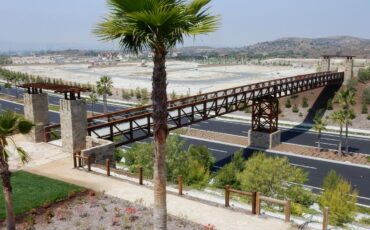
Traditionally bridges have been a major, multi-stage, undertaking. Excel bridge combines the conceptualization,
design and fabrication into one step. This efficiency and specialization reduces costs and project time lines.
- Excel's design/build/prefabricate method reduces total costs to 1/3, or even 2/3, less than traditional methods.
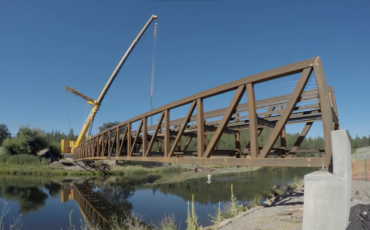
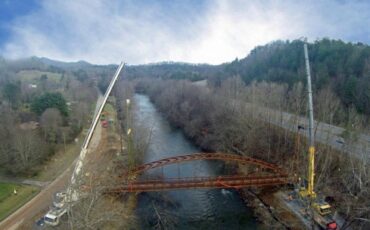
- The super structure itself usually requires 1 to 6 hours to erect.
- Steel truss bridges can clear much longer spans than girder types, thereby reducing or eliminating the need for piers.
- An additional benefit is that the bridge will be a complete finished "product," with a ten year warranty.
Pre-fabricated bridges, like most custom manufacturing, vary tremendously in cost depending on the size and on the
features chosen. Equally important is how and what combination of highway bridge codes (AASHTO and DOT variants) or
building codes (AISC, IBC, UBC or BOCA) are applied to the structure. There is no national agreement on what codes,
loads, and stresses should apply to pedestrian bridges, so the specification is done per the collaborative judgments of consultants,
owners and local governments.
All the examples below are based on 5 ton pickup truck or ambulance sized vehicle capacities. These estimates are for
clear span bridges delivered to you, using steel pricing from 2005. Every bridge is custom designed and featured.
"Models" like the Montecito®, Keystone®, or P1-SQ® are only generalized types.
Additional costs to consider, not included below, are:
- Crane rental and the labor to erect the bridge.
- Concrete for the deck if applicable.
- Designing and building the abutments and piers.
DO NOT rely on these numbers, they are only to help you grasp the scope of possible costs. Please call to discuss your
particular project for more accurate estimates.
To provide you with some very generalized help, here are some over simplified examples for the cost of delivered bridges
NOT INCLUDING abutment or erection costs:
Typical 30' to 120' bridges with made from weathering steel, with wood or concrete decks, inside bridge widths from 6' to 12', usually range from $500 per linear foot (plf) up to $900 plf.
Typical bridges, the same as above, except clear spanning 125' to 180', may range from $700 plf to $1400 plf.
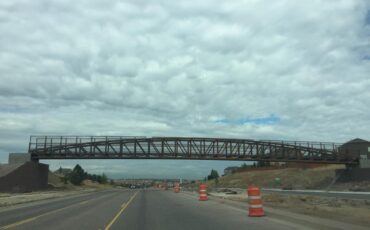
Typical box truss bridges, usually fenced on all sides for a highway overpass, cost about 30-40% more than the above examples.
Important variables that affect price: (more ROUGH rules of thumb)
- Painted bridges are usually 15-25% more (click here for weathering steel pro/con).

- Bow truss type can add about 10-20% over parallel chord trusses.
- Applying AASHTO for the design stresses typically adds about 15-20%. This is mandatory for bridges with impact loads from fast moving vehicles, but many engineers in this field opine that AISC is the best stress design code for most pedestrian bridges.

- Girder types over 30' long can be 0-15% over the truss type, but up to 90% higher as the length approaches 100'.

- Longitudinally spliced bridge nested for shipment
Wider bridges with decks from 13' to 16' are usually delivered with a longitudinal splice and the decking material will be installed on site. Expect 20% to 40% higher cost, plus erection time will increase from a few hours to 1-2 days.
These factors can affect price significantly but cannot be quantified without considering project particulars:

- Larger vehicles: Applying a pickup truck (5 ton or H5) vehicle load usually has little effect on cost. Vehicles of 6-7.5 tons do typically cause a noticeable bump up in price. H10 trucks are the next step higher. HS-20 trucks for fire, propane, construction, etc., will increase cost significantly up to double the cost or more. For skid steer loaders and other construction/maintenance vehicles you must know the actual axel dimensions and weights. For budget estimates please call, generalizations cannot reliably be made for these kinds of vehicle loads.
- The 100 year flood event: The consultant and the local authorities must decide how big a flood event you are designing the bridge to avoid or withstand.
- These bridges have been designed to withstand 12 fps of stream load assuming the truss railing is filled with debris and has become a dam. This drives costs significantly higher. Break-a-way designs are sometimes used when the bridge cannot be raised out of the flood plain but water back up from the damming effect is unacceptable. Many break-a-ways have a cable imbedded into the abutment in an attempt to prevent the bridge from tumbling downstream causing injury. Some field reports indicate success with this strategy, often rescuing and reinstalling the bridge.
- Attempting to raise the bridge above the flood water not only affects pier heights and bridge length, but the allowable below deck depth of structure as well. Requiring a very shallow below deck depth for long spans can change the look and cost of your bridge considerably. Despite this, pony and box trusses still provide the best top of deck to lowest member dimension and cost.
- The American Disabilities Act sometimes causes small additional costs by adding features, but sometimes can cause major cost increases as it affects the construction of the trail. These problems usually center around the conflict between the limits of how much slope is allowed in the trail verses how high the bridge must be to clear the flood events (see point immediately above). For views of the types of bridges and their below-deck structure, click here.
- Clearance over traffic lanes or rail road cars, is similar to the two points above. To over simplify: truss bridges under 70' need at least one foot from top of deck to lowest member. Over 100' and this dimension jumps usually to a minimum of 22" to 30". If something is limiting your depth of structure please call to discuss the options. Don't forget the ramps and/or stairs to get on the bridge; sometimes the bridge cost becomes secondary to these structures.
Other significant costs that are outside the scope of Excel Bridge's work are:
- The crane to set the bridge.
- Accessibility
- Environmental issues. These can impact your timeline, pier possibilities, and more.
- Concrete for the deck, if you chose that kind of deck.
- Designing and building of the concrete abutments.
|
|
 |
|
 |